Thursday, March 28, 2013

Presidential Deaths: Part Two

President: Benjamin Harrison
Date: March 13, 1901
Age: 67
Cause of Death: Pneumonia
Last Words: "Doctor, my lungs!"
Place of Burial: Crown Hill Cemetery, Indianapolis, Indiana


President: William McKinley
Date: September 14, 1901
Age: 58
Cause of Death: McKinley was shot twice in the stomach by an anarchist named Leon Czolgosz. He later died of the infection that one of the bullets caused inside him a.k.a. he had gangrene all up in there.
Last Words: "We are all going." Said to his wife when she asked God to take her too.
Place of Burial: McKinley National Memorial, Canton, Ohio


President: Theodore Roosevelt
Date: January 6th, 1919
Age: 60
Cause of Death: Roosevelt was sickly as a young boy, and was warned that he couldn't live the strenuous life by doctors. He took this as a challenge and lived more times than any person ever. His body finally wore out after dealing with a bullet wound infection (he was shot while giving a campaign speech for the 1912 election) and the malaria he contracted while on his extremely dangerous expedition mapping the River of Doubt in South Africa. He died of a heart attack while sleeping, causing Vice-President Thomas Marshall to say, "Death had to take Roosevelt sleeping, for if he had been awake, there would have been a fight."
Last Words: "Put out the light."
Place of Burial: Youngs Memorial Cemetery, Oyster Bay, New York

President: William Howard Taft
Date: March 8th, 1930
Age: 72
Cause of Death: Heart attack. Taft was known as the fattest president of all time and even allegedly got stuck in a tub. So how come he lived a full ten years longer than Roosevelt? Taft, for one, didn't have the same nagging health issues that Roosevelt had, and secondly, he actually lost a ton of weight after his presidency, probably elongating his life by quite a few years. Death comes for all, however, and Taft was still overweight, thus making his heart attack an inevitable thing.
Last Words: Unknown
Place of Burial: Arlington National Cemetery, Arlington, Virginia. He was the first President to be buried there.

President: Woodrow Wilson
Date: February 3, 1924
Age: 67
Cause of Death: Cerebral Hemorrhaging. Wilson had been battling a bout of influenza in 1919, which eventually caused him to suffer a severe stroke. He was unable to function as President for much of the rest of his second term and instead sent his wife to go to cabinet meetings. The public had no idea Wilson was incapacitated, and wouldn't know until after his death. He died a few years after the presidency of another stroke and heart complications.
Last Words: "I am a broken piece of machinery. When the machine is broken, I am ready."
Place of Burial: Washington National Cathedral, Washington D.C.
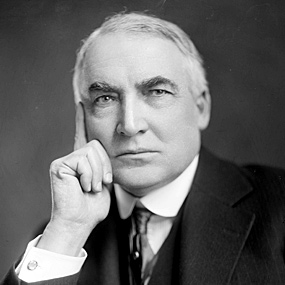
President: Warren G. Harding
Date: August 2, 1923
Age: 57
Cause of Death: Stroke, Pneumonia, enlargement of the heart, take your pick. All basically caused by high blood pressure. Harding's presidency was racked with scandals made possible by the friends he put in and around his cabinet, which in turn caused his blood pressure to skyrocket due to stress. Nobody ever said being President was easy. Sometimes it can kill you.
Last Words: "That's good, go on, read some more."
Place of Burial: Harding Tomb, Marion, Ohio

President: Calvin Coolidge
Date: January 5th, 1933
Age: 60
Cause of Death: Heart attack
Last Words: "Good morning, Robert."
Place of Burial: Plymouth Notch Cemetery, Plymouth Notch, Vermont


President: Herbert Hoover
Date: October 20, 1964 (Yeah, think about that one for a while. This guy was around during the 60's)
Age: 90
Cause of Death: Internal Hemorrhaging  Hoover, having died 31 years after leaving office, had the longest retirement from the presidency, up until Jimmy Carter continued to live through 2012. Hoover, having so long to do it, partially rehabilitated his reputation. Same goes for Carter, I think.
Last Words: "Levi Strauss was one of my best friends." (Yes, that one)
Place of Burial: Herbert Hoover Presidential Library and Museum, West Branch, Iowa

President: Franklin D. Roosevelt
Date: April 12, 1945
Age: 63
Cause of Death: Technically he died of a stroke, but the real cause was the polio that had struck him in his early 40's. The wear on his body due to the paralysis, plus smoking, plus the immense stress of the presidency basically wore his already weak body down to nothing. He died, not in the company of his wife, Eleanor Roosevelt, but his former mistress, Lucy Mercer. Yikes.
Last Words: "I have a terrific pain in my head."
Place of Burial: FDR National Historic Site, Hyde Park, New York

President: Harry Truman
Date: December 26, 1972
Age:  88
Cause of Death: Pneumonia
Last Words: Unknown
Place of Burial: Harry S. Truman Presidential Library and Museum, Independence, Missouri


President: Dwight D. Eisenhower
Date: March 28, 1969
Age: 78
Cause of Death: Heart failure. He would have died from his body poisoning himself, due to his stomach being all blocked up. Doctors did he surgery to save him, though they knew it would weaken his heart. He was able to live one more month before succumbing to heart failure. The doctors were widely criticized for performing the surgery, though Eisenhower would have died sooner had they not done so.
Last Words: "I'm ready to go. God, take me."
Place of Burial: Eisenhower Presidential Center, Abilene, Kansas

President: John F. Kennedy
Date: November 22, 1963
Age: 46
Cause of Death: Shot in the head while being driven in a open roofed vehicle. Popular belief is that Lee Harvey Oswald acted alone in the shooting, though many conspiracy theories exist that point the finger at different organizations or people.
Last Words: "That's very obvious." He said this after being told that Dallas loved him.
Place of Burial: Arlington National Cemetery, Arlington, Virginia. It's the one with the eternal flame.


President: Lyndon B. Johnson
Date: January 22, 1973
Age: 64
Cause of Death: Heart failure caused by many years of smoking, bad diet, and stress.
Last Words: "Send Mike immediately."
Place of Burial: Johnson Family Cemetery, Stonewall, Texas

President: Richard Nixon
Date: April 22, 1994. It's weird to think that I was alive during the same time as Nixon.
Age: 81
Cause of Death: A blood clot from his heart condition broke off and traveled all the way up to his brain, causing a stroke.
Last Words: Unknown
Place of Burial: Richard Nixon Presidential Library and Museum, Yorba Linda, California. Fun Fact: Nixon was a Quaker. Bet you didn't see that coming.

President: Gerald Ford
Date: December 26, 2006
Age: 93. Ford was the longest living of all the presidents, beating Reagan by 45 days. Take that, Gipper!
Cause of Death: Cerebrovascular disease
Last Words: Unknown
Place of Burial: Gerald R. Ford Museum, Grand Rapids, Michigan. Finally, one I can easily drive to.

President: Ronald Reagan
Date: June 5, 2004
Age: 93
Cause of Death: Pneumonia brought on by Alzheimer's
Last Words: Unknown
Place of Burial: Ronald Reagan Presidential Library, Simi Valley, California

That's all of them! Carter (88), Bush Sr. (88), Clinton (66), Bush Jr. (66), and our current President Barack Obama (51) are all alive and kicking. 


Tuesday, March 19, 2013

Presidential Deaths: Part One

OK, so I realize this is a little bit morbid, but I'm going to be focusing on the deaths of all our beloved Presidents. Some have gone out with a bang (no pun intended), and some went quietly  So, I'm basically going to give the name, date, age, the cause of death, place of burial, and last words (if there were any).

President: George Washington
Date: December 14th, 1799
Age: 67
Cause of Death:  Pneumonia/Throat infection. Washington had been out riding around his plantation for hours in the snow and freezing rain. He later ate supper that night without changing out of his clothes. He woke up in the morning with a severely sore throat. As was the practice at the time, he was bled several times by doctors. He died shortly after from his ailment.
Last Words: The last words written in his journal are: "'Tis Well."
Place of Burial: Mount Vernon, Virginia

President: John Adams
Date: July 4th, 1826
Age: 90 (he held the record for longest living President until Ronald Reagan)
Cause of Death: Being incredibly old. He had a heart attack probably caused by arteriosclerosis.
Last Words: "Thomas Jefferson survives." Jefferson did not live, he had died a little before Adams.
Place of Burial: United First Parish Church, Quincy, Massachusetts.

President: Thomas Jefferson
Date: July 4th, 1826
Age: 83

Cause of Death: Jefferson was basically stuck in bed for the last year of his life, suffering from various illnesses. His death is attributed to either dehydration from dysentery or complications from pneumonia.
Last Words:  "Is it the fourth yet?" It was. Jefferson died within the hour. Both Adams and Jefferson, the best of friends and the worst of enemies died on the 50th anniversary of the signing of The Declaration of Independence. Spooky.
Place of Burial: Monticello, Charlettsville, Virginia. The epitaph on Jefferson's grave says nothing of his tenure as President, just lines about him being the writer of the Declaration of Independence, the father of the University of Virginia, and lover of the separation of church and state. Everything Jefferson owned had to be sold off since he died poor as dirt. He didn't spend money wisely and often bought lavishly for interior decorating.

President: James Madison
Date: June 28th, 1836. Madison was the last of the Founders to die.
Age: 85
Cause of Death: Old age/heart attack
Last Words: "I always talk better lying down."
Place of Burial: Montpelier, Virginia


President: James Monroe

Date:  July 4th, 1831
Age: 73
Cause of Death: Combination of heart failure and TB. No, not Taco Bell...Tuberculosis. I wouldn't mind dying by Taco Bell, though.
Last Words: His last words were actually about James Madison. "I regret that I am about to die without again beholding him."
Place of Burial: Originally buried at the New York City Marble Cemetery, he was later transported to the Hollywood Cemetery in Richmond, Virginia.


President: John Quincy Adams
Date: February 23rd, 1848
Age: 80

Cause of Death: Two days earlier he had been in the House of Representatives who were discussing if they should present swords to honor officers of the Mexican-American War. While everyone yelled out "ayes" in favor of this, Adams, who was completely against this, stood up and shouted "No!" He then had a massive stroke and fell into his fellow House member's arms. He died two days later. So, I guess you could say that he was struck down by God for being a jackass.
Last Words: "I hate every single one of those lousy Mexican-American war veterans! I'll give them a sword straight up their...*cough* *cough* *wheeeeeze* *eye's rolling back*." OK, that wasn't really it, but I'm sure it entered his head a few times after the stroke. His real last words were: "This is the last of earth. I am content."
Place of Burial: United First Parish Church, Quincy, Massachusetts. Same as his father.

President: Andrew Jackson
Date: June 8th, 1845
Age: 78
Cause of Death: Jackson was one of the more sickly Presidents. He had a bullet stuck in his lung from a duel and it caused him to have terrible headaches and a chronic cough. He eventually died of a combination of chronic tuberculosis, dropsy, and heart failure. Geez, talk about overkill.
Last Words: "Oh do not cry, and be good children-we will all meet in Heaven."
Place of Burial:  The Hermitage, Nashville, Tennessee.


President: Martin Van Buren
Date: July 24th, 1862. Van Buren outlived his four successors.
Age: 79
Cause of Death: Heart failure and bronchitis. Ain't nobody got time for that.
Last Words: "There is but one reliance."
Place of Burial: Kinderhook Cemetery, Kinderhook, New York


President: William Henry Harrison
Date: April 4th, 1841. Remember, he died a month after he was elected. Bad luck.
Age: 68
Cause of Death: Harrison developed a cold a few weeks after his inauguration and it got worse from there. The popular theory that he got the cold from his lack of coat and hat at his freezing inaugural address is apparently untrue. He died nine days after getting sick, officially of pneumonia and jaundice.
Last Words: Spoken to his doctor, but probably meant for John Tyler: "I wish that you could understand the principles of government. I ask them to be carried out. I ask nothing more." The doctor was probably like, "Yep, I'll get right on that."
Place of Burial: North Bend, Ohio

President: John Tyler
Date: January 18, 1862
Age: 71
Cause of Death: He suffered from continuous bouts of dysentery at the end of his life, but most believe he died from a stroke.
Last Words: "Doctor, I am going. Perhaps it is best."
Place of Burial: Hollywood Cemetery, Richmond, Virginia. Fun Fact: Tyler is the only President to not have his death recognized in Washington. Tyler allied himself with the Confederacy in his old age even going so far as to join their House of Representatives, thus he was basically disowned by the U.S. government at the time. Jefferson Davis had a memorial for him instead.

President: James K. Polk
Date: June 15, 1849. Polk had the shorted retirement from the presidency at 103 days. He is also the youngest President to die in retirement.
Age: 53

Cause of Death: Polk entered the presidency full of life and left it with little left. He is probably the only President that made a list of goals for his presidency and actually accomplished all of them. This had its drawbacks, however. He contracted cholera in New Orleans during a goodwill tour in the South and it gradually got worse.
Last Words: "I love you, Sarah. I love you for all eternity." Awww...too bad he too was speaking to his doctor. Just kidding....I think.
Place of Burial: State Capital grounds, Nashville, Tennessee

President: Zachery Taylor
Date: July 9th, 1850
Age: 65
Cause of Death: This one is sort of a mystery. Taylor had been consuming a ton of cold milk and cherries during a holiday celebration, and he became very ill a few days later. He most likely died from cholera, severe diarrhea, or perhaps even a severe case of gastroenteritis. He was the second President to die in office.
Last Words: "I regret nothing, but I am sorry that I'm about to leave my friends."
Place of Burial: Zachery Taylor National Cemetery, Louisville, Kentucky

President: Millard Fillmore
Date: March 8, 1874
Age: 74
Cause of Death: Stroke, paralysis.
Last Words: Being fed soup: "the nourishment is palpable."
Place of Burial:Forest Lawn Cemetery, Buffalo, New York


President: Franklin Pierce
Date: October 8th, 1869
Age: 64
Cause of Death: Pierce was quite the drinker. By that, I mean he was enough of one to die of cirrhosis of the liver.
Last Words: "I'm not as think as you drunk I am." That's my best guess, as nobody knows what his last words were.
Place of Burial: Old North Cemetery, Concord, New Hampshire. He also allied himself with the Confederacy during the war, but was still honored in Washington at the time of his death, seeing as the war was over.

President: James Buchanan
Date: June 1st, 1868
Age: 77
Cause of Death: Buchanan caught a cold and it worsened due to his advanced age. He died of respiratory failure.
Last Words: "I shall carry to my grave the consciousness that at least I meant well for my country. Oh, Lord God, as thou wilt." Buchanan was fully aware history would not look back kindly on his presidency. He had received threatening letters from the time he left office til his death, mostly for not doing anything to stop the war.
Place of Burial: Woodward Hill Cemetery, Lancaster, Pennsylvania

President: Abraham Lincoln
Date: April 15th, 1865
Age: 56
Cause of Death: Lincoln was shot in the back of the head by John Wilkes Booth while watching Our American Cousin at the Ford's Theater. Lincoln was the first President to be assassinated.
Last Words: "She won't think anything of it." Lincoln had been asked by his wife, Mary Todd, whether it was alright that they hold hands, since Miss Harris could see it. Cute and incredibly sad.
Place of Burial: Oak Ridge Cemetery, Springfield, Illinois

President: Andrew Johnson
Date: July 31st, 1875
Age: 66
Cause of Death: Johnson had a few strokes and died from complications.
Last Words: Uttered to his daughter after having a stroke and falling out of his chair: "My right side is paralyzed. I need no doctor. I can overcome my troubles."
Place of Burial: Andrew Johnson National Cemetery, Greensville, Tennessee


President: Ulysses S. Grant
Date: July 23rd, 1875
Age: 63
Cause of Death: Grant loved to smoke a good cigar. So much so that it gave him throat cancer. Yikes.
Last Words: "I hope that nobody will be distressed on my account."
Place of Burial: Grant's Tomb, Manhattan, New York City, New York. It is the largest mausoleum in America, and one of the largest in the world. If anyone asks you who is buried in Grant's Tomb, say no one, since both Grant and his wife are entombed, not buried. Ha, ha, Groucho, we get it.


President: Rutherford B. Hayes
Date: January 17th, 1893
Age: 70
Cause of Death: Heart failure.
Last Words: "I know that I'm going where Lucy is." His wife, "Lemonade" Lucy, had died four years before, and after that point, Hayes basically wrote that there was nothing left for him in life.
Place of Burial: Spiegel Grove State Park, Fremont, Ohio


President: James Garfield
Date: September 19th, 1881
Age: 49
Cause of Death: Garfield was shot twice in the back by Charles Guiteau, a insane office-seeker. Garfield would have survived the wounds, but his doctors poked around his insides too much and he got an infection. The infection later caused a heart attack, so I guess that's technically his cause of death.
Last Words: "My work is done."
Place of Burial: Garfield Memorial, Lake View Cemetery, Cleveland, Ohio


President: Chester A. Arthur
Date: November 18th, 1886
Age: 57
Cause of Death: Arthur suffered from Bright's Disease, a kidney disease now known as chronic nephritis, which caused him to feel slow and tired. People thought he was lazy, but it wasn't that, he was just slowly dying. He died shortly after his presidency of the disease.
Last Words: Unknown
Place of Burial: Albany Rural Cemetery, Menands, New York


President: Grover Cleveland
Date: June 24th, 1908
Age: 71
Cause of Death: Cleveland was one of our more heftier presidents and this didn't serve him well in his old age. He eventually died of heart failure.
Last Words: "I have tried so hard to do right."
Place of Burial: Princeton Cemetery, Princeton, New Jersey


Thursday, March 14, 2013

Assassins: Leon Czolgosz

Leon Czolgosz was born in Alpena, Michigan in 1873. Wooo! Michigan!...oh wait. How come all the killers have to come from Michigan? I know the weather sucks most of the time, but it's not that bad. There is a little bit of confusion of where the Czolgosz's came from. It was either Prussia, or modern day Belarus. Whichever it was, they hadn't been in America very long, landing in America in 1860's. Perfect timing! Nothing was happening then! Father Czolgosz's real last name was the infinitely easier to spell, Zholhus, and I can only assume he changed it to drive me insane while I attempt to write out Czolgosz a hundred times. Which is why I will only refer to Czolgosz by his first name. The Czolgosz's moved to Detroit when Leon was five and then eventually ended up in Warrensville, Ohio. Seeing as this was a nation that didn't care about child labor at the time, Leon left the family farm in Warrensville and started working at the local steel mill at ten years old, along with his two brothers. The Czolgosz boys were fired from the job after the workers went on strike. After staying at the family farm for a little while, Leon went to work at a glass factory, this time at sixteen years old. In the two years that he stayed and worked at the glass factory, he witnessed many more strikes and the violence that came from them. Tiring of this, he went back home once more. Too bad home wasn't stress-free for Leon. He didn't get along with his step-mother, and didn't agree with his family's Roman Catholic beliefs. Leon had always had trouble with relationships. He didn't make any friends as a child and was bullied constantly by peers. This pain, on top of his family troubles turned him into a recluse. Not looking too good for old Leon, is it?

In his reclusive state, Leon started to read Socialist and anarchist literature. He slowly became more and more entranced by the ideals of the two groups, culminating in his trip to Cleveland in 1901 to see political radical, Emma Goldman, speak. He quickly approached her after her speech and asked her for some reading recommendations. A few days later, he showed up at her house, calling himself Nieman (no man). So yeah, that's not creepy at all. Goldman said she had a train to catch, but would introduce him to some of her anarchist friends at the train station. Leon was convinced that there was a terrible injustice happening in America. The rich kept getting richer, and the poor getting poorer. The rich exploited the poor, leading to their continued bliss. Leon blamed the inequality on the structure of the government, but wasn't sure how to properly fight it. All these anarchists were just talk. He must be a man of action. Then, it came to him, in the form of a news story from Europe: King Umberto I of Italy had been assassinated by anarchist Gaetano Bresci. Bresci told the press after the assassination that he was taking matters into his own hands, for the people's sake. This pushed little Leon over the edge, though it galvanized the anarchist movement in America.

Anarchist had taken their toll on Europe, killing half a dozen officials and members of the Royal Houses. Fear began to spread in America of this new idealism. Even to identify yourself as an anarchist in New York was considered a breach of the peace. With Umberto's murder, there began to be a growing concern for the life of the president. Lincoln and Garfield had been assassinated within the last forty years, so who was to say that it couldn't happen again? Probably the person who feared this most was Secretary to the President, George B. Cortelyou. Cortelyou and members of the president's cabinet urged newly re-elected President William McKinley to please have some security around him. This wasn't going to happen. McKinley was too much of a man of the people! He couldn't be seen as a cold and distant president. In fact, this is why all the presidents didn't have security on them 24/7; they didn't want to seem out of touch. That would all change after McKinley was assassinated. From Theodore Roosevelt on, the President had Secret Service men with them whenever they were outside the White House, though Roosevelt constantly tried to lose them.

Leon moved to Buffalo, New York, for reasons unknown, though some historians speculate it was because of the large Polish population there. Leon heard that the President would be making a stop in Buffalo, and he knew this was his chance. He later told police that:

It was in my heart, there was no escape for me. I could not have conquered it had my life been at stake. There were thousands of people there on Tuesday. I heard it was President's Day. All those people seemed bowing to the great ruler. I made up my mind to kill that ruler.

Leon was convinced that the only way to solve things and bring back equality to America was to kill the tyrannical ruler of it: President McKinley. Was Leon right about there being a great inequality in America? Yes. Did he go about it the wrong way? Most definitely. Leon promptly went to buy a gun from a local store, a .32 caliber Iver Johnson to be exact. He wasn't quite sure how he was going to do it, but all he knew is that he had to get close to the president. McKinley's train arrived in Buffalo to a cannon salute from the city. The cannon ended up being to close to the train car and it blew out a bunch of the windows. People flipped out, assuming it was a bomb that went off, and starting screaming, "Anarchists!" McKinley was not unnerved and stepped off the train for his official welcome. Who was at the train station at that moment? None other than Leon. Leon pushed through the crowd once he saw the president step off the train, but the president was too well guarded for him to get a decent shot. Leon retreated. Part of the President's trip itinerary was to visit Niagara Falls, then the next day go to The Temple of Music at the Exposition grounds to meet the people. Cortelyou, his secretary, was extremely wary of McKinley's visit to The Temple of Music and tried to take it off the President's schedule twice, but the President put it back on each time. He had to meet the people! There was no need for alarm! McKinley even told Cortelyou that there was no need for concern, because no one would want to harm him. Cortelyou was not convinced of this and asked that there be extra security at the Exposition grounds.

The day before the public meeting at The Temple of Music, McKinley gave what was to be his last speech. In front of 50,000 fair-goers, McKinley talked of the end of isolationism and of new trade agreements that would allow US manufacturers new markets. Leon had arrived early that day and considered shooting the President during the speech, but Leon wasn't convinced he could get an accurate shot, especially with a bunch of people elbowing him. He gave it up for that day and headed off to his hotel room. Leon was confident that he would have his moment at The Temple of Music. McKinley arrived to the large auditorium to the "Star Spangled Banner" and prepared for his favorite part of the job: shaking hands. He was an experienced politician and could shake hands with fifty people a minute. That's pretty darn fast! McKinley was only allotted ten minutes to shake hands with people, something Cortelyou probably saw to. After five minutes, Cortelyou signaled for his men to close the doors and stop more people from coming in. The line stopped abruptly when 12-year old Myrtle Ledger, who was accompanied by her mother, asked if she could have the red carnation that McKinley always wore on his lapel. He accepted and let the young lady take his carnation. This is where things get a little spooky. That red carnation wasn't just any old carnation; it was his lucky red carnation that he never stopped wearing. I don't believe in luck, but this is a pretty crazy coincidence! A swarthy, nervous looking man was approaching McKinley now, and security started to get suspicious. They breathed a sigh of relief when the man shook the President's hand, and went on his way. The policy that all shaking hands with the President must have their hands open and free was not being enforced. It was terribly hot, and many people had handkerchiefs to wipe away the sweat. So nobody thought it odd when the next person after the swarthy man came up to the president with his right hand wrapped up. Probably presuming that the man had injured his hand, the President went to shake the man's left hand. When they touched hands, two shots rang out. The man was Leon Czolgosz. He had concealed the handgun in the bandages and got one good shot in the President's abdomen. The other shot just grazed him.

McKinley lurched forward and Leon attempted to shoot him a third time, but the man in line behind him promptly slammed into him, trying to get the gun out of his hand. Then Leon had a bunch of men on him, some punching him, some hitting him in the head with a rifle. Leon was heard saying, "I done my duty." McKinley was helped to a chair by Cortelyou and others and tried to convince them he wasn't badly hurt, though everyone could see he was bleeding profusely. McKinley observed the men giving Leon the beating of a lifetime and ordered them to stop, claiming that Leon obviously didn't know what he had just done. When Leon wouldn't stop looking at McKinley as he was being searched, Secret Service Agent Foster knocked him to the ground with one punch. McKinley was taken from the building in an electric-powered ambulance and on his way to the hospital pulled out the bullet that had grazed him. Lucky for him it had hit one of his buttons and barely hit him. The other bullet, however, would not be found at all. The hospital that McKinley ended up at had an area for surgery, but not a qualified doctor, only nurses and interns. The best doctor in the whole city, Dr. Roswell Park, was away at Niagara Falls performing a delicate neck operation and told messengers that he wouldn't leave the operation, even if it was for the President of the United States. He was told that was exactly who it was for, and Park attempted to finish up and get to the President. The only doctors on hand were Dr. Mynter and Dr. Mann, who gave McKinley a shot of morphine and attempted to find the bullet after giving the ailing President some ether. They opened him up and saw all the damage the bullet had done, but not the bullet itself. Dr. Mann guessed it had lodged itself in McKinley's back muscles and wouldn't do any harm. They stitched him up just in time for Dr. Park to show up. McKinley was woken up and taken to the Milburn House to recover.

The last known photo of President McKinley
Word had spread fast about the shooting and many feared that McKinley wouldn't survive the day. Cortelyou attempted to settle everyone's fears by reporting that McKinley was recovering well. This didn't satiate those who wanted revenge on Leon. An angry mob formed around the jail he inhabited and when they found out he was an anarchist, anyone known to be, or rumored to be an anarchist was sought out. This was happening all over the U.S., culminating in a man almost being lynched in Pittsburgh. Yeah, people go a little crazy when a ruler is assassinated. McKinley was doing well at the Milburn House. He was able to finally see his wife, and welcomed Cortelyou, Vice-President Roosevelt, his whole cabinet, and Senator Mark Hanna to visit. They all eventually left, feeling that McKinley would make a full recovery. Roosevelt must have been really confident the President would live, as he took a trip to the Adirondack Mountains. Roosevelt fumed that all Leon would get is ten years in prison for attempted murder. What everyone didn't know is that the inside of McKinley's stomach was slowly becoming gangrene, the usual cause of death for those shot in the stomach before advanced medicine. The President was dying, albeit slowly and with a ton of pain killer. A few days later, McKinley took a turn for the worse and Roosevelt was called back from the Adirondacks, where he was probably climbing the highest peak for the seventh time that day. McKinley started to fall in and out of consciousness. The doctors attempted to make him better, but he knew he was dying. He asked all those present to say a prayer with him and he (or Ida McKinley) sang his favorite hymn. Ida was removed from the room because she couldn't stop crying, and no one but McKinley's oldest friend, Mark Hanna was left. Hanna was just as distraught as anyone over what had befallen his friend, and was dismayed when McKinley didn't respond to his voice. William McKinley died at 2: 15 am on a Saturday, September 14th, 1901.

Dr. Mann and fourteen other doctors performed an autopsy to find where the bullet lay. The bullet had passed through his stomach, his transverse colon, and nicked his left kidney on its way to disappearing inside the peritoneum. Modern doctors speculate that McKinley was as good as dead the moment the bullet entered him. He is most likely to have died from pancreatic necrosis, something that is extremely hard to treat in this day in age, so the likelihood of him surviving then was slim to none. A death mask was made of McKinley's face, with a short service being held at the Milburn House. He was then moved to the County Hall in Buffalo for five days of national mourning. He was laid to rest in Canton, Ohio where there is now a memorial. McKinley's name is all over the place in not only Canton and Ohio, a state that has twenty schools named after him, but also states around the country. Mount McKinley, the highest point in all of North America is even named after him.

As soon as word got out that McKinley had died, Leon was transferred from jail to a penitentiary to await trial. Leon talked freely with his guards at the prison, but refused to talk to either of his two lawyers, or the psychiatrist sent to test his sanity. The fact that Leon refused to talk to his lawyers made their case a hard one to make. Leon even refused to defend himself in court! He literally just sat there and watched it all unfold. This is far different from Charles Guiteau's trial, where Guiteau turned the courthouse into a zoo (not literally, though that would have been awesome). One thing that was like Guiteau's trial was the defendant's lawyers trying to get an insanity plea. They begged the jury to acquit Leon of 1st degree murder and send him instead to an insane asylum. But it was not to be. The jury took one hour, then came back with the verdict: Guilty, and the sentence was death....by electrocution. Leon returned to Auburn Prison and was soon strapped into the last chair he would ever sit in. His last words were: "I killed the President because he was the enemy of the good people-the good working people. I am not sorry for my crime." Right before he was electrocuted he said through clenched teeth that he wish he could have seen his father one last time. Leon's brain was autopsied afterwards by scientists, probably to see if they could find the part of his grey matter that was crazy. He was buried in a simple black coffin in the prison grounds, though the hole was filled with sulfuric acid so the body would be completely eaten up. It was probably so no one would steal his bones later, but I'd like to believe that they were just keeping his ghost/zombie from coming back and wreaking havoc on the populace. Leon was only twenty-eight when he was sent to his death. This is a weird thought for me, since I'm very near that age, and it seems crazy that a person my age went and shot the president.

A couple things happened due to McKinley's death at the hand of Leon Czolgosz. The most important was the fact that now Theodore Roosevelt was President and it was going to take more than an anarchist with a gun to take him down. Roosevelt made sure there were new laws made against anarchist, though they lay dormant until WWI. America truly entered a new age when Roosevelt became President. Trust-busting, jingoist, environmental, imperialistic change! Things did not get better for anarchist, as you can imagine. Emma Goldman and anyone else Leon had conversed with in his travels were brought in and questioned. The government was convinced that Leon didn't act alone, though he himself claimed otherwise. All who were arrested were soon let go, though Goldman had to sit in jail for three weeks before she was let go. She sympathized with Leon, and that sympathy didn't make her popular, even with other anarchist. She would eventually be jailed and eventually deported to Russia in 1917 for apparently encouraging people not to register for the draft. The last thing that changed is something that I already talked about; the fact that the President had to have the Secret Service around at all times. The President had to deal with looking separate from the public; it was either that or potential death at any moment. The Temple of Music where the crime took place was torn down later that year, as was the rest of the Exposition. There is a marker in the middle of Fordham Drive showing the exact place where McKinley was shot. One last note on Leon Czolgosz: Lloyd Vernon Briggs reviewed Leon's case along with others who had histories of mental illness before they committed murder and found that Leon was no different. Judging from his anti-social behavior and inability to form relationships, there is a strong case that Leon was mentally ill, and had been for a very long time. He felt there was a large question of whether Leon could be held accountable for the President's death. That will remain a mystery to us, however, as we can't really dig Leon up and ask him questions. All it does is give us further questions on how we determine if a person can be held responsible for their actions when they have a history of mental illness.

Tuesday, February 12, 2013

Mardi Gras

Yeah! Wooo! Mardi Gras! Gonna go crazy and collect beads! Oh wait, I've never been to or celebrated a New Orleans Mardi Gras. I have been in New Orleans while it was going on though, and let me tell you...they didn't let us anywhere near Bourbon Street. It was a band trip, of course they weren't going to let us go nuts. Mardi Gras, or Fat Tuesday when translated to English from French, is the day where everyone indulges. Traditionally it's when people will eat fatty foods so as to prepare themselves for the Catholic tradition of Lent (where you are supposed to fast), which starts the next day on Ash Wednesday, but the American celebration has led to other indulgences. How did we get to masks, beads, nudity, and fatty foods? Well, let's go back a ways. *Cliche flashback noises and visuals*

According to New Orleans' city website and official sponsor of the colors purple, gold, and green, "the origins of Mardi Gras can be traced to medieval Europe, passing through Rome and Venice in the 17th and 18th centuries to the French House of the Bourbons. From here, the traditional revelry of 'Boef Gras,' or fatted calf, followed France to her colonies." In the late 1600's, our old friend, Jean Baptist Le Moyne Sieur de Bienville, landed south of New Orleans and, when the crew realized it was the eve of Mardi Gras, named it "Pointe du Mardi Gras." Bienville also established "Fort Louise de la Louisiane" (now called Mobile) in 1702. The following year, the town celebrated Mardi Gras for the first time in American history. A secret society soon sprouted up in 1710 called the "Boef Gras Society, which paraded through the city every Mardi Gras until 1861. Along with the parade would be a bull, a fake one used at first, that was draped in white, signaling the start of Lent. Bienville later established New Orleans in 1718, with Mardi Gras celebrations becoming a mainstay from the get-go. The governor of New Orleans decided that parades weren't enough for the holiday, and started the tradition of elegant balls being held.

Mystic societies began to form in New Orleans in the mid 1800's, the oldest being the Mistick Krewe of Comus. They cemented the tradition of a formal parade made up of costumed and masked people walking through the New Orleans streets every Mardi Gras. The parades became more and more elaborate over the years, with floats, bands, and street performers. Mardi Gras become synonymous with New Orleans, and vice versa. It wasn't just a French or Catholic thing now, as everyone in the city enjoyed the celebration. The celebrations helped give New Orleans its nickname, "The Big Easy." It has only been in the late 20th century that the whole beads and the showing of breasts became a tradition of sorts, catering to the spring break crowds and voyeurs who can't get enough of Girls Gone Wild videos.

Fat Tuesday is also called Shrove Tuesday, Shrove being the past tense of the word Shrive, which means "to confess." This follows the whole absolution for sins through confession. It follows the tradition of Mardi Gras in being a day where you eat a lot before you can't eat at all. Shrove Tuesday isn't a term that's widely used today, and if it is, it's only by certain countries. In the U.K., Ireland, Australia, New Zealand, and Canada, it's referred to as Pancake Day, a day in which the fatty food they eat is pancakes, obviously. Also popular in many European countries is the pancake run, in which people run through the streets with a pancake on a frying pan, flipping it up and catching it as they go. The tradition apparently comes from the story of a woman so busy with making pancakes that when the church bells rang, she ran out to the church with the frying pan with the pancake still in her hand. In Poland, hey traditionally celebrate Shrove Thursday, the Thursday before Ash Wednesday. Their traditional fatty food of choice is the Packzi (pronounced Poonch-key or Punch-key), a high fat jelly doughnut-like pastry. In America, the day is usually celebrated along with Mardi Gras, in cities where there are a large amount of Polish immigrants, namely Chicago, Buffalo, and the Detroit suburb of Hamtramck. I, myself am from metro Detroit, so Packzi's are something that are well known to me and my fellow south-east Michiganders (or Michiganians if you like). The Spanish and Portuguese celebrate Carnival instead of Mardi Gras, focusing on masquerades and parades. Probably the most famous example of this is the Brazilian Carnival in Rio De Janeiro.

All the foods that are consumed on Shrove Tuesday and Mardi Gras are typically made from rich foods such as eggs, milk, and sugar. Thus why most center around pancakes and pastries. Lent lasts for forty days and in that time people refrain from the finer indulgent foods such as meat, dairy, and eggs. Yikes, not sure I could go that long without those three things. In England, it used to be a big tradition to play football (not our version) on Shrove Tuesday, going back to the 12th century.  The tradition died out when the Highway Act of 1835 banned people from playing football on public highways. So, I guess people liked to play games in the road back in the day? Several towns in England have kept up the tradition, though I doubt they play on highways (they do play in blocked off roads though). That would be a European sport that I would watch!

In all, Mardi Gras is just a day where you get to be someone else by dressing up, eat pancakes or pastries, or run around in a parade. It's like having a huge party the day before your parent's are coming back from vacation, and since they never get pizza, you order...like...twenty. So, if you don't happen to be in the vicinity of New Orleans, or other southern towns that celebrate with parades, take some time to eat your heart out, even though if you aren't Catholic, you don't have to stop eating the fun stuff.

Monday, November 5, 2012

The Electoral College and You!

I'm not sure if I just didn't pay attention in class or if my teachers didn't quite hit the subject as hard as they should have, but I knew nothing about the voting process until a few years ago. OK, I wasn't completely in the dark, but I never knew what function the electoral college had. I just knew that we all voted, the votes were counted, and whoever got the most in that state got all the electoral votes. It's a little more confusing than that. When we cast our ballot, we are not voting for the president, but a person that will vote for the president. Confused yet? The electoral college is filled with a bunch of people that are assigned to each party. Let's say that Michigan votes Democrat again, as they have since 1992. The Democratic Party receives all the electoral votes for Michigan, which in this case is now 16. If you've been keeping track, our electoral number was 17 last election. The electoral numbers for each states are reassessed after every census, so it would make sense that our number would change from 2008 to 2012, seeing that the last census was in 2010. If you remember government class, then you'll remember that our representatives are based on the population of the state. You take that number, plus the amount of senators we have per state, which is two, and you have the amount of electoral votes your state has! The electoral number can be as high as it wants to be, the current champion being California with fifty-five. The lowest a state can get, however, is three. Washington D.C., per the 23rd Amendment, is allotted the same amount of electoral votes as the lowest electoral number state, which is three. It does not matter if the population of D.C. is greater than Wyoming, it will always be three.

Anyway, so Michigan's popular vote shows that it has voted for Barack Obama let's say, so the Democratic Party is now allowed to cast its votes for Barack Obama. Seems kind of redundant, right? Why not just have it to where we just vote for the president and not for an elector? Well, way back when they were setting up how to vote for president, they realized that the states with little to no population would basically have no voice in who was elected. If there are 500,000 people in New York, but only 20,000 in Vermont, whose voice is going to be heard? The founders decided the best way would be to have an electoral college decide the president instead of a popular vote, as to give small states a bit more power in deciding who would lead them. The bigger reason for the electoral college, however, was slavery. Slavery basically dictated how all our documents were finalized, as the Constitution and even the Declaration of Independence had to delete anything that was critical of slavery lest they offend the south and not get both documents accepted. The mode of electing the president went the same way. Though men like James Wilson and James Madison preferred choosing the President by way of popular vote, Madison himself realized that "it would be difficult to get consensus on the proposal given the prevalence of slavery in the South." The population of the North at that time greatly outnumbered the South, so any election would favor the North. That is, unless the we had let African-Americans vote, but that wasn't going to happen at that time. There was no winning for the South unless we went to an elector system. So, in a roundabout way, you can blame our electoral process on slavery.

Who can be an elector in the electoral college? Well, it is usually people that are well connected inside of their respected party. It really matters on what state you belong to. In most, electors are nominated by their state political party months before the election. Other states nominate the electors in primaries, similar to how presidents are selected. Other states, such as Oklahoma, Virginia, and North Carolina nominate electors at party conventions. There is a stipulation that no representative or senator can be an elector, nor anyone who has sworn allegiance to the United States and then rebelled. That last part was more for all those who took part in the confederacy, though Congress could reinstate them to be an elector if they receive two-thirds vote in both houses. Now here comes the messed up part about the whole process. As an elector, you can cast your ballot for whomever you want. If you are a Democrat and decide to betray your party by voting Republican, you can. In other words. there is a weird way in which all the electors in your state could totally change what the majority wanted. These people are called Faithless Electors. The faithless are few and far between and most happen by accident, due to writing in the wrong name, or choosing the vice president nominee's name for president and vice-versa. There have been a few times where electors have defied their party and voted for another candidate on purpose. In the 2000 election, Barbara Lett-Simmons, a elector from D.C. did not submit her vote at all, though she was pledged to Al Gore and Joe Lieberman, due to D.C.'s lack of representation in Congress. In 1972, Roger MacBride decided not to vote for Richard Nixon and Spiro Agnew and instead voted for Libertarians John Hospers and Theodora Nathan. There are many more, and can be seen here. Many states, including my state of Michigan, have a law punishing faithless electors, though no one has ever been tried. Besides a law in some states, what keeps people from stabbing their party in the back? Well, if you decide to be a faithless elector, you can kiss your political aspirations goodbye. It is literally political suicide. You probably couldn't even find a place with the party you defied your old one for, as you would be marked as unreliable.

So, a short review. You cast your ballot, you are actually voting for an elector, you hope and pray elector actually votes for who they say they will vote for, we all count electoral votes, first one to 270 wins. One last little note about the electoral votes: Maine and Nebraska do not go by winner takes all. They assign an elector to each district and they vote which way they want. This is a fairly recent thing for both states and neither have ever split their electoral votes. Now, there are a few people that don't like the way we elect the president. And by that, I mean most people. There are a large amount of people who believe that we should decide the president by popular vote. This comes from the times that the president has received enough electoral votes, but didn't have the most popular votes. That literally means that more people in the country wanted one president, but somehow, the other got elected. Silly, huh? This has happened three times, in 1876, 1888, and 2000. We all remember 2000 and saw for ourselves how the electoral college kind of failed us. Another thing that could happen, but has only happened once is a deadlocked election. In 1824, nobody received the minimum amount to be president. Andrew Jackson received the most electoral and popular votes, but it wasn't enough. Per the 12th amendment, the House of Representatives had to decide. Henry Clay, who ran, but since he came in fourth place was not allowed to be considered anymore. Clay was a member of the House and used his influence to give not Jackson the presidency, but John Quincy Adams. See the problem? Now, we are basically stuck in a two party system, so I don't see this happening again, but you never know what the future holds.

Another argument against the electoral college is the amount of time the nominees focus on swing states and forget the rest. States like Texas, New York, and California have voted a certain way for a very long time, and thus don't warrant much attention from the candidates (The maps on the left show the amount of visits each candidate made in the last five weeks of the election in 2004 via hands, and each dollar sign is a million dollars spent on advertisements . Michigan, Iowa, Florida, Ohio, and Pennsylvania, among others, to warrant attention. Lots of attention. These states can go either way, and they all have a good amount of electoral votes, so they are the ones that the candidates focus on. Small states, like the big three I mentioned before, are also ignored, for they are basically split down the middle how they vote, plus who cares about three measly electoral votes when you can get twenty? In turn, voter turnout suffers in those states that are ignored due to their heavily entrenched political identity. Why vote if you know how your state is going to vote? Proponents argue that the popular vote would give people a reason for going out to vote, as they would feel more like they are making a difference. I agree with this, as we should be encouraging all people to vote, not just those that are in swing states.

There are those that do support the electoral system, however. Those who do claim that if we decided the president by popular vote, the only places that would matter would be high volume areas like cities, and therefore rural areas would lose their say. Proponents also claim that the electoral system benefits smaller states and minorities. Minorities, who might not be heard in a popular vote, can make a difference in a electoral system. A more unusual pro for the electoral system is that if an elected president dies, the electoral college could decide on another for us, instead of us putting in a dead person. That seems a little unusual and unlikely, so I don't buy that one. I honestly don't think the electoral college is going anywhere, barring a huge election faux pas. There have been many times where someone has tried to submit an amendment to the Constitution that would change all this, but as you can see, they have all been shot down. I honestly think both sides make some good points, and no election process is perfect, but it does seem like there is more going for the popular vote. That is just my opinion, so take it or leave it. Sorry this post was a little dry. Like Sahara dry, but I thought it would be useful to some if they knew how voting worked in our political system. No matter what, please go out and vote tomorrow, mostly because you can. Some may argue that your vote doesn't count in the long run, and they may be correct. But, so many others around the world don't have what we have, so we should be taking advantage of our freedom, not looking at it with cynicism.