Tuesday, April 24, 2012

Jeannette Rankin

Hooray! It's my 100th post! Who has the distinction of being the subject of my 100th post? None other than Jeannette Rankin! Who is that you ask? Someone you should be familiar with, that's who! Rankin was the first woman to be elected to congress, plus the first elected woman to a legislative position in any Western democracy. Pretty cool, huh? How did she get to that coveted position? Well, after graduating from the University of Montana and working as a teacher, seamstress, and social worker, she, at the age of 30, joined the fight for women's right to vote in Montana."Men and women are like right and left hands," she declared. "It doesn't make sense not to use both." Rankin and the women of Montana got their wish in 1914 when Montana gave women the right to vote. Not being pleased with just being able to vote, Rankin decided that she was going to run for state legislature. In the end, Rankin beat out seven male rivals to become the first woman elected to Congress in 1916.

Congress wasn't exactly welcoming, however. The congressional wives were unfriendly, afraid she'd have designs on their husbands. The U.S. Capitol at that time had no bathrooms for women-there'd never been a need. To make matters worse, four days after she took her seat, Rankin made the extremely unpopular decision to vote against America's entry into WWI. Though she was not the only one to vote against entry into the war, she was still the object of much scorn in Congress. Despite the political setback, Rankin championed several causes during her two years in Congress: women's rights, birth control, equal pay, and child welfare. Her baby, however, was the Susan B. Anthony Amendment, which she introduced in 1919 on the floor of the house. The Amendment, which passed and was ratified by the country as the 19th amendment to the Constitution, gave all women in America the right to vote. Susan B. Anthony and Elizabeth Cady Stanton drafted the amendment all the way back in 1878 and introduced it to Congress first. Public opinion about women voting had turned in the last couple years, which allowed the amendment to finally get ratified, with Rankin's help. "If I am remembered for no other act," she later said. "I want to be remembered as the only woman who ever voted to give women the right to vote."

Though the 19th amendment was a triumph for Rankin, her earlier anti-war vote had sealed her political fate. When she ran for the Senate in the next election, she was soundly defeated. That didn't stop her fire for peace however, as she worked in the Women's International League for Peace and Freedom, and the National Conference for the Prevention of War in the decades following her two year stint in Congress. Then, in 1940 at the age of 60, Rankin made another successful run for Congress on the slogan, "Prepare to limit for defense; keep our men out of Europe." Later, when we were attacked at Pearl Harbor, FDR asked Congress to declare war on Japan. Rankin was the only person to vote nay. Her vote caused a near-riot in the House chamber. She was showered with boos from the angry crowd in the gallery and had to hide in a phone booth until the Capitol police escorted her out. She was the only member of Congress to vote against both world wars.

She never ran for office again, though she kept with her anti-war ways by leading the Jeannette Rankin Brigade-5,000 women in black-in a silent protest march on Washington against the Vietnam War. Before Rankin passed away at 92, she said, "If I had my life to live over, I'd do it all the same-but this time I'd be nastier."

Thursday, April 5, 2012

Assassins: Charles Guiteau

I know I didn't start off with a well known assassin, but Guiteau is probably one of the most interesting. If not interesting, the craziest. Guiteau is the poor fellow who assassinated President Garfield. What's that? You don't know anything about either of them? Well, that's pretty typical, as the only thing people know about Garfield is that he got shot, and others don't even know that much. They just know that he shares the name of a certain comic strip feline. Allow me to at least illuminate crazy old Guiteau. Guiteau was born in Freeport, Illinois in 1841, the fourth of six children. His life was marked by ups and downs, as evidenced by his mother dying when he was just fourteen, but then inheriting $1,000 dollars from his grandfather so he could go to college. He decided to try his hand at the University of Michigan in Ann Arbor, though wasn't able to attend since he failed the entrance exam.

He bummed around Ann Arbor until his father sent him a bunch of letters telling him to join this really awesome cult...er...utopian religious sect that Poppa Guiteau was really fond of: The Oneida Community. The group preached group marriage and free love, lest you go on and marry just one person, which would be selfish. In fact, John Noyes, the religion's founder, probably invented the notion of free love in the modern sense. Guiteau stayed there for about five years but never really fit in. In fact, they nicknamed him "Charles Gitout." Guiteau left the community twice, the first to start a Oneida religion newspaper, which failed, and the second just to get away from Noyes and his followers. Guiteau subsequently tried to sue Noyes, as he felt Noyes owed him tons of back pay for all the work he did during the five years he was at the community. Suffice to say that nothing ever came of it, and Poppa Guiteau sent a bunch of letters to Noyes apologizing for his son, calling him "irresponsible and insane."

Guiteau traveled around until he realized what his true calling was: practicing law. Though he was completely underqualified for being a lawyer, Guiteau got extremely lucky when he got an easy entrance exam that consisted of only three questions, two of which he answered correctly. He opened his own firm in Chicago and basically acted as a bill collector, only going to court a few times. But in those times he was in court he was quite the spectacle. Either he would be wholly unprepared for his cases or wouldn't even address his client's charges, instead deciding to give lectures on religion and philosophy. His clients were not happy. After basically getting run out on a rail, he decided to try his hand at theology. He printed out a pamphlet that was basically word for word Noyes' work and would distribute it at the random towns that he visited. Few would show up to his advertised sermons and began to heckle him after only hearing a few sentences. Guiteau was not doing too well.

Most of Guiteau's family had deserted him. His father was done trying to keep his son from making a fool of himself and even his big sister, whom had raised him as if she were his mother, couldn't help feeling that Guiteau needed to be committed. She had loved her brother so much, but judging from his behavior the last couple times he had stayed with her and her husband, he was possibly a danger to those around him. She attempted to have him committed but he took off before they could apprehend him. Everyone around Guiteau saw how delusional he was, except of course Guiteau himself. Guiteau perhaps went completely off the deep end when he was a passenger on the SS Stonington. The Stonington had hit the SS Narragansett due to a heavy fog, leading to the SS Narragansett to first burn, then sink. The Stonington, however, was able to make it back to port with no loss of life. Guiteau felt that he had been spared by God; meant for a divine purpose that he didn't know yet. This part of the story is always a little funny to me, since Guiteau was on the ship that had no casualties at all and didn't sink, yet he found himself lucky to be alive and basically thought himself marked by God as a person what would carry out his will.

With this new delusion, Guiteau turned to politics. Guiteau wrote a pamphlet titled "Grant vs. Hancock" about the upcoming election in 1880. Guiteau meant the pamphlet to voice his support for the Republican candidate Ulysses S. Grant, who had already served two terms and now was trying for a non-consecutive third. There was only one problem with Guiteau's pamphlet: it had the wrong Republican candidate. Guiteau, like many others in the U.S. thought that former President and Union General Ulysses S. Grant was a shoe in for the nomination. However, much to everyone's surprise, Garfield included, James A. Garfield secured the Republican nomination. This was very interesting considering that Garfield had never wanted to be president. He considered the congressmen who devoted their lives to being president as becoming shells of their former self. Many had been ruined by the fight for the white house, and Garfield wasn't going to be one of them. Garfield did speak at the Republican convention however, though it was for support of John Sherman, brother of William Tecumseh Sherman, for president. Garfield's speech to the delegates caused many to consider Garfield a great compromise candidate. The convention had held thirty-six ballots to finally decide the winner, which fell to Garfield since nobody seemed to want to give enough votes to anyone else. Garfield protested the whole time, but saw his nomination coming towards him like a speeding train.

Now that the reluctant nominee was in the official running and not Grant, Guiteau had to change his pamphlet. In the end, he only changed the name, nothing more. Luckily for Guiteau, Winfield Scott Hancock was a shoe in for the Democratic nomination. Guiteau passed his pamphlets out to anyone he could, but only gave a speech supporting Garfield twice. When Garfield won, Guiteau felt that he was the one who had won the election for Garfield, that his pamphlet had swayed the masses and decisively won it for the Republicans. For this service, he asked the Garfield administration for an ambassadorship. Ambassador to Vienna! That's it! No, wait! Paris is way better! He was rejected several times, and finally told to never return by Secretary of State James G. Blaine.

OK, so I know what you're thinking. Why would this joker even bother asking the President for a job? Well, this was because of a little thing called the spoils system, or patronage. The spoils system is basically where candidates have their friends raise money for them and in return, the friends get a job in the new administration! That is, if that candidate wins. The spoils system had been around since Jackson and to say the least, its caused some problems. Remember Grant's presidency? People talk a lot about how corrupt his cabinet and administration was. Well, you can blame the spoils system for that. Grant filled all the spots in the white house with his friends who gave him campaign money. Too bad they were greedy idiots who didn't know anything about their jobs. Things did not go well for Grant in that respect. Nevertheless, there was a whole group in the Republican party that believed that the spoils system was the only way to go. They were called the Stalwarts. The other side of the Republican party was moderates, or as they were affectionately called, "Half-Breeds." The two sides hated each other, which doesn't spell success in the long run. However, with moderate Garfield getting Stalwart Chester A. Arthur the Republicans somehow pulled it off. Even though Garfield didn't believe in the spoils system, instead believing that they needed civil service reform, people still lined up at the White House demanding jobs for the money they gave or the work they put in for the campaign.

This was the last straw for Guiteau. All he wanted was some recognition for all the hard(?) work he had done. Something snapped in Guiteau's head and he decided he had to do something drastic. He was going to be remembered by everyone, even if it wasn't for his law business, or religious and political speeches. So, he went out and bought a handgun. Guiteau wanted to buy the revolver with the ivory handle, as it would look nice in a glass case at a museum exhibit, but couldn't afford it. Guiteau then went about learning how to shoot a gun, and stalking Garfield. Guiteau was ready to kill the president at any time, but needed the perfect moment. He had the chance at a train station while Garfield was seeing his wife Lucretia off, but Guiteau had known that Lucretia was not feeling well and didn't want the assassination to upset her any further. Oh how thoughtful of him!

Guiteau couldn't wait forever though, and finally decided to wait around at the same train station on July 2nd, 1881. Mind you, this is less than four months since Garfield was sworn in. Guiteau paced inside the train station and even got his shoes shined waiting for Garfield to show up. Garfield was excited that he was finally going to be able to join his wife, as they were going to spend some time at a beach resort in New Jersey. Finally seeing Garfield and James G. Blaine walking through the train station, Guiteau stepped out into the open railroad station and shot Garfield twice in the back, the second shot piercing his first lumbar vertebra but missing the spinal cord. After shooting Garfield, Guiteau yelled out, "I am a Stalwart of the Stalwarts...Arthur is now President!" Guiteau quickly made his way to one of the many exits as panic ensued, but was quickly apprehended by a security guard who was surprised that Guiteau didn't put up any fight.

Garfield survived for months before dying of inections, most likely due to his doctors not using clean medical tools or washing their hands. Many modern doctors find that if sterile medical tools were used, Garfield would have made a full recovery. Incidentally, the use of sterile medical tools became commonplace just ten years later. Way to go, people. Guiteau sat in jail until September when he finally went on trial for the murder. Guiteau, feeling that he could defend himself better than any "high profile lawyer" wanted to represent himself. He didn't get his wish. His lawyers came up with a pretty good idea though, that actually could keep him from being put to death: the insanity plea. In fact, this was the first high profile case that had a person using the insanity plea. The defense even had a doctor come in to diagnose Guiteau, whom he found to have always been crazy, possibly from "a congenital malformation of the brain." Of course, the prosecution called shenanigans on the insanity plea and claimed that Guiteau had just wanted to get famous.

The case dominated the news, mainly because of the behavior of Guiteau inside the courtroom. Guiteau would constantly insulted the judge, jury, witnesses, the prosecution, and even his defense team. Good strategy! He would often speak in epic poems and even soliciting legal advice from random spectators in the audience via passed notes. He dictated his autobiography, ending it with a personal ad for "a nice Christian lady under 30 years old." Guiteau was completely oblivious to the fact that everyone in America hated him. Even after almost getting assassinated twice, he would still wave happily to spectators and reporters, seeming to be very happy that he was finally in the spotlight. Guiteau even sent Chester A. Arthur a letter telling him that Arthur should let him go since Guiteau had just given him a pay raise. The funny thing is, Guiteau knew that he didn't actually kill Garfield in the end, the doctors did. He brought up this fact in his trial, but it didn't have any legal support. Guiteau was so sure that he was going to be let go that he planned to go on a lecture tour and run for president in 1884. Good luck, buddy! Guiteau was eventually found guilty and sentenced to death. Upon hearing this, Guiteau stood up and shouted at the jury, "You are all low, consummate jackasses!"

Guiteau appealed his conviction but was denied and was hanged on June 30th, 1882, only two days before the anniversary of the assassination. Guiteau was said to be happy till the very end, smiling and waving to everyone and dancing on his way to the gallows. He recited a poem he had written called, "I am Going to the Lordy," and requested that an orchestra play during his reading of the poem. The request was denied. Guiteau is officially the longest living assassin of a president, living almost a whole year after the murder. What was the outcome of Guiteau's story? Well, the usually Stalwart Chester A. Arthur decided to change his tune because of public opinion of the spoils system. Arthur passed the Pendleton Civil Service Reform Act of 1883 which stated that people could only be given jobs if they passed a test proving they were qualified for the position.

Thursday, January 26, 2012

Presidential Paycheck

It's easy to say that our presidents didn't get into the job for the money. The power, now that's another story. The president does get paid a lot, but there are plenty of other jobs that pay much better. Our current President makes $400,000 a year plus a $50,000 dollar expense account. Compare that to presidential hopeful Mitt Romney. Romney recently released his tax return and according to it he makes around $22.5 million every year. In other words, he makes about $57,000 a day. So give him around eight days and he's already making more than the president gets from the government. Romney comes from a wealthy family, plus a lot of the income comes from the time he spent as founder and partner of Bain Capital, a private equity firm. So it's really safe to say that Romney is not in need of that sweet presidential paycheck. Obama may not have a large company that he founded, but he still did pretty well last year with a total of $5.5 million, most of that coming from book sales.

Logically, you'd think that Obama is the highest paid president, as the presidential paycheck has gotten higher and higher over time. Not true. Obama is in fact number 8 on the list of lowest paid presidents. How is that possible? Inflation my dear boy! Think of it like the list of highest grossing movies of all time. Avatar is the highest grossing movie in total earnings. That isn't adjusted for inflation however. When adjusted, Avatar goes all the way down to 14th, while topping the list is Gone With the Wind. Bet you didn't expect that. Well, some of you might have. Anyway, going by the way inflation works, the highest paid president could basically be anyone. The answer may surprise you: William Howard Taft. Yes, the man who got stuck in a tub was our best paid president. Taft was paid just $75,000 dollars a year in his time. In our time however, he was making $1,445,454 a year. Mckinley, Nixon, Wilson, Theodore Roosevelt, and Cleveland all made over $1 million a year when adjusted for inflation. Who got paid the least then? Bill Clinton, that's who! Clinton made $200,000 a year plus a $50,000 expense account, which is worth $282,648 today. Other presidents on the lowest paid: Andrew Johnson, Madison, H.W. Bush, John Adams, Lincoln, Jefferson, Monroe, Obama, Reagan, and Washington.

Most of the lowest paid come in before President Grant because they all made $25,000 year. It wasn't until Grant's second term that Congress started giving presidents raises. Why give the presidents raises? It's not because the president is underpaid, but because Congress feels it is. "Traditionally, no government employee can make more than the president. Yet unlike the president, many of them have built cost-of-living increases into their salaries. When their pay starts butting up against that of the president's, they tend to become more generous." A few fast facts about presidents and their salaries:
  • Presidents since Truman have had a $50,000 expense account.
  • George Washington, Herbert Hoover, and John F. Kennedy refused their salary (Washington instead had a never ending expense account, Hoover and Kennedy were already loaded).
  • While many presidential expenses are picked up by other departments and agencies, not all of them are: Thomas Jefferson left office owing $10,000 just for wine (Jefferson was terrible with money).
  • Incidentally, the two presidents who were impeached are also the two lowest paid presidents. Somehow Nixon is the third highest.
  • Presidential pensions started being doled out by Congress in 1958. It started out at $25,000 per year and included both and office and staff. The payment is now based on the annual pay of a cabinet secretary: in 2001 this came out to $161,200.
  • Joe Biden doesn't get peanuts either. He receives around $220,000 a year for being vice-president.
Do the presidents deserve such a paycheck? I think so. They are the leader of the free world. Plus plenty of presidents before Super Pacs had to put in a bunch of their own money into running for office. They might as well make a little of it back. Plenty of the presidents could have used the pension money, as some had to write a book(Grant), or take up other positions to keep afloat the rest of their lives. Some were not so lucky. Remember how I said Jefferson was bad with money? Though he was born into a rich slave owning family, Jefferson died deeply in debt. Too much interior decorating and partying. I'm serious. So, don't ever feel bad for the presidents from the last sixty years or so. They did rather well for themselves and a lot of the more recent ones have all written books to help boost their net worth. I guess my whole point is: our presidents are filthy rich.


Romney Tax information from: http://thecaucus.blogs.nytimes.com/2012/01/24/romney-tax-returns-to-give-view-of-family-wealth/

Obama annual income from: http://www.huffingtonpost.com/2012/01/26/mitt-romney-tax-returns-clues-character_n_1233772.html

All other information from: Uncle John's Bathroom Reader Plunges into the Presidency. "The Buck Stops Here." Pgs. 79-81.

Wednesday, January 25, 2012

Candidate Mudslinging

We in the 21st century are no strangers to attack ads during election season. In fact, it's almost impossible not to see one on every channel come September of an election year. In these attack ads and at debates, one candidate does their best to make the other candidate look like they aren't cut out for the job. Most of the time it's about the issues, but sometimes it gets personal. Many in the public feel that the personal attacks are a little bit below the belt, but what we witness today is nothing compared to what went on in the early years of the republic. Instead of the prim and proper politics we all think about when we picture early America, it was more like an all out brawl.

Take for instance the elections between John Adams and Thomas Jefferson. The two sides had handed out handbills and articles accusing each other of misdeeds during the 1796 election. This was but a prelude. Jefferson was just a little bitter that he lost to Adams and when the 1800 election rolled around, Jefferson decided to get personal. Jefferson and his followers called Adams a hypocritical, bald, blind, crippled, and toothless old fool. In his bid to become "King of America" he would marry his children to those of King George III and would rule over the country like a tyrant. Not only was he a monarchist, but a whoremaster, too, and had sent his running mate to Europe to procure prostitutes. Adams' side was not any kinder to Jefferson. They accused Jefferson of bilking creditors and business partners; giving in like a coward as governor of Virginia when the British invaded his state during the Revolutionary War; and cheating an old widow out of her husband's pension. They claimed Jefferson was a "howling atheist," and if he were elected he would confiscate and burn all the Bibles in America; tear down all the churches; put an end to the institution of marriage; and clap the country's women into bordellos. The Hartford Connecticut Courant warned that if Jefferson was elected "murder, robbery, rape, adultery, and incest would be openly taught and practiced. The air will be filled with the cries of the distressed, the soil will be soaked with blood, and the nation black with crimes." Dang! Can you imagine any of our presidential candidates saying those things about another candidate? Sure some things are insinuated, but nobody thinks that if Gingrich is nominated that the soil will be soaked with blood and the air will be filled with the cries of the distressed.

The elections between John Quincy Adams and Andrew Jackson were no less severe and personal. Adams' side claimed that Jackson was an adulterer, a liar, a bigamist, and a murderous drunk who gambled on cockfights. They went as far as to point out all the American citizens that Jackson had "killed, slashed and clawed" to death in various brawls and duels. Jackson wasn't the only target; they also went after his family. They called Jackson's mother a prostitute who'd been imported by the British as comfort for the English Revolutionary War troops. Worst of all for Jackson, they picked on his dear wife Rachel, who was vulnerable due to a problem with her divorce from her former husband, which wasn't granted until after she'd married Jackson. They called Rachel an adulteress and a paramour, causing the Jacksons great personal pain. Jackson's side shot back by calling President Adams an elitist tyrant who lived in a "presidential palace" in "kingly pomp and splendor." He traveled on Sunday instead of going to Church; installed "gambling tables and furniture" in the White House on the public's bill; and had premarital sex with his wife Louisa. Jackson ended up winning the 1828 election, but it came at a cost. His wife died soon after from a heart attack. Jackson lived the rest of his life believing that it was because of the slings and arrows she weathered during the campaign.

Now these are two extreme examples, as these candidates really hated each other. Candidates these days may not like who they run against, but its nothing personal in most cases. Not so in the old days. Some of the old school presidents were extremely bitter people who had nothing better to do then make the other candidate look like the anti-christ. Sure, some candidates today may bring up embarrassing family members or a string of divorces, but it's hard to compare attacks today to those of the past. Enjoy the election this year!

Information from Uncle John's Bathroom Reader Plunges into the Presidency, "Getting Dirty" pgs. 116-117. Sorry, I don't have more precise sources.

Thursday, January 12, 2012

The Duel

Even by just naming this post, "The Duel," most people have a good idea in their head which duel I'm talking about. While there were plenty of duels fought during our history, one has gone down as the most infamous. Why? Mostly because it involved the country's vice-president and the first Secretary of the Treasury. You'd think that this story is pretty cut and dry, or so history textbooks would make you think so. Most know that Burr and Hamilton didn't like each other, but they're not sure why. They know that at the duel the two men shot at each other and Hamilton ended up getting fatally wounded. Hamilton is the martyr for the Federalist cause while Burr is a cowardly dog that shot the intellectual giant. Like usual, the textbooks get it wrong, or at least leave out important segments. Textbooks cannot be expected to expound on every situation so I can't hold too much against them. However, history is written by the winner, and Hamilton, though he died, won.

Before I get to the duel, I'll give you a little bit of background on our players. Hamilton "was born on the West Indies island of Nevis, the illegitimate son of a down-on-her-luck beauty of French extraction and a hard-drinking Scottish merchant with a flair for bankruptcy. In part because of his undistinguished origins, Hamilton always seemed compelled to be proving himself; he needed to impress his superiors with his own superiority (Ellis, 22)." That being said, Hamilton had a certain way of doing things, a passion you could say, that put him at odds with other powerful people. Though he meant it to be libelous, John Adams' description of Hamilton as "the bastard brat of a Scotch peddler" was undoubtedly true. From that little snippet you can tell that Adams didn't much care for the charismatic financial wizard and high ranking officer that Hamilton was. Adams was a bitter enemy to Hamilton, and they were in the same party, though Adams belonged to the more moderate side of the Federalist. At the very top of the list of Hamilton's foes would be Thomas Jefferson. A Democratic-Republican, Jefferson constantly butted heads with his former cabinet mate.

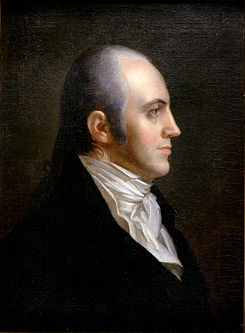
Aaron Burr on the other hand, had come from a more "distinguished bloodline" which gave his aristocratic bearing its roots and biological rationale. Burr was kind of an odd duck to say the least and made a few interesting decisions in his life. Most of them involved undermining the United States and creating his own country, but we're not talking about that today. Burr really didn't belong to any one party. He may of been Jefferson's vice president, but he had support from the moderate wing of the Federalist, and after it was clear that Jefferson would drop him as his second in command after he was re-elected, Burr tried to run as a Federalist for the governorship of New York. It didn't work out. Hamilton noticed Burr's lack of alliance to any one party and constantly insulted Burr in conversation by referring to him as "totally unprincipled" and "despotic in his ordinary demeanor."

So, how did things boil down to a duel between the two men? Well, it turns out it was an issue of name-calling. The Albany Register had published a letter in which the author, Dr. Charles Cooper, recalled Hamilton questioning Burr's qualifications for being governor of New York. Further into Cooper's letter, the word despicable came up in description of Burr by Hamilton. Burr found out and that was the last straw. Nobody, but nobody called him despicable! Just picture Burr getting all bent out of shape in the same way Marty McFly did when someone called him chicken. Honestly, Hamilton had been dogging Burr for years, talking behind his back and insulting him whenever he got the chance. Burr simply had enough of it. He demanded an apology from Hamilton. Hamilton basically responded by saying he couldn't apologize for something he doesn't remember saying. That really got Burr going. They sent a bunch of letters to each other demanding apology, one for what he allegedly said, the other for trying to make him apologize for something he may not of said. Friends of theirs even tried to intervene, but it was no use. Hamilton even eventually apologized for what he said, but by that time Burr wanted to humiliate Hamilton. He wanted a blanket apology for everything Hamilton had ever said to him. This would stand and things eventually devolved into Burr challenging Hamilton to a duel. Hamilton was slightly confused by the whole thing, as he made it perfectly clear to Burr that he said such things in political circles, and was not meant to be taken personally. Burr's feelings were apparently hurt and he would have his satisfaction. Why didn't Hamilton refuse? The short answer is that he felt that the mere act of refusing a duel would be tantamount to political suicide. He could never be trusted again by his fellow politicians and would have to basically go into early retirement.

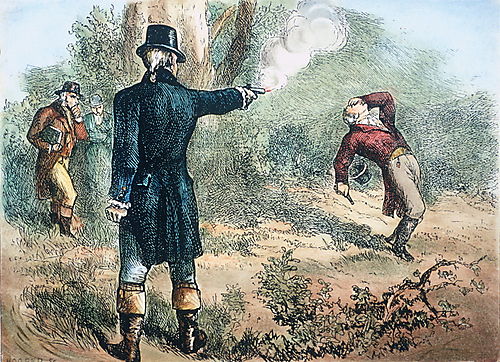
Duels were very much illegal at that time in many of the states, including their home state of New York, so they had to find a secret place to have the duel. Oh, and they weren't officially called duels. They were instead referred to as "interviews." You may be thinking to yourself how stupid that is, but this duelist vocabulary created a "language of deniability" if any of them had to testify in court. Things also functioned under the code duello, which was basically the unwritten rules on how everyone didn't get caught doing this completely illegal practice. As such, in Hamilton's and Burr's duel, many of the people present weren't allowed to watch, just for the fact that they could honestly say that they didn't see anything. The famous picture of the duel (above) is therefore inaccurate, as it shows many witnessing the duel. In reality, only the two men's seconds witnessed what happened. The doctor present had to literally turn his back on the whole thing, while the rowman that took them there had to stay in the boat and look the other way. In essence, this code duello would lead to the entire duel being shrouded in mystery.

Let me give you a little more background on duels in general back in the day. The two men had there seconds, which were the only ones to witness the duel, and also gave the men their weapons. It was also their job to start the count after someone shot and missed. They were given the count of three then the duelist had to fire or they lost their turn. At ten paces, the two men would face each other and basically wait for someone to make their move. Most duels ended with no one hitting each other, honestly. The guns they used at that time may of been incredibly powerful at close range, with their large rounds and all, but they were also incredibly inaccurate. If both men missed, then they decided whether their honor was satisfied, and if not, they shot again. Most, if they were really mad but didn't want to kill the other person, aimed at the others legs or hip and tried to graze them. So, in essence, the duel was this odd ritual that was done not to kill one another, but to convince each other that the mere act was a representation that they were man enough to get shot at. At least that's my interpretation.

Weehawken would be the site of the duel, a out of the way ridge in which Hamilton's oldest son had lost his life in a duel to protect his father's honor. Yikes. The two other main players in this ordeal were each man's second. Hamilton's was named Pendleton, and Burr's Van Ness. Since Hamilton was the challenged, he got the choice of weapons. He chose the very same guns used at his son's duel. Creepy. Hamilton, before the duel started, had talked to Pendleton and stated that he was going to miss on purpose, giving Burr a chance to pause and reflect. Hamilton didn't think Burr would then shoot him. It was a gamble, but one that he thought he could win. Lets fast forward a bit to the end of the duel. Trust me on this one. Two shots rang out and Hamilton had been shot. "The one ounce ball had struck him on the right side, making a hole two inches in diameter about four inches above his hip. the projectile fractured his rib cage, ricocheted off the rib and up through his liver and diaphragm, then splinted the second lumbar vertebra, where it lodged (Ellis, 25)." Hamilton immediately collapsed. Though not his dying words as I once was led to believe, he remarked to the doctor present that he knew this was a fatal wound. It turns out that even with our fancy newfangled medical technology, we could never have saved the man. Burr's shot had literally tore his insides apart. That being said, he was a goner and everyone knew it. He was taken ashore to a friends house and died early in the morning. Burr, after seeing what happened, seemed visibly shocked and full of regret. He tried to go to Hamilton, but Van Ness led him away exclaiming that they had to get out of there. Burr tried to force his way back, claiming that he had to talk to the dying Hamilton, but Van Ness basically dragged him away.

We then come to the mystery of it all. Van Ness and Pendleton were literally the only ones who saw what happened, so logically whatever they said of the duel was true. This turns out to be false, as the only thing that the two agreed upon and put into a joint statement was that two shots were fired and that there was a long pause between the shots. This could also be backed up by those not watching, as they could tell based on sound. Pro-Hamilton people claimed that Burr had shot first and killed Hamilton right out. Burr's people claimed that Hamilton aimed and missed and it was only right that Burr wait for the count and shoot. He just happened to shoot the poor man. Van Ness and Hamilton's supporters claimed that Burr had shot him and in the surprised impact, Hamilton also shot off his gun, though in the air into a tree. This theory has credence in that investigators did find the tree to be badly damaged when they studied it the next day, and Hamilton's warning on the boat to handle his gun delicately, as he hadn't shot it. So, Hamilton in his mind had not wanted to take a shot at Burr, but in the confusion of it all, had shot and didn't realize it, as they both went off at nearly the same time. The only problem is the charge that the shots were fired far apart. So, the Hamilton side of things can't be right.

On Burr's side, people claimed that Hamilton had indeed shot at Burr, but missed. Burr waited four or five seconds for the smoke to clear and then took a shot. He would have probably lost his turn had his second been counting. It turns out he was too distracted by the first shot. So, Burr took it upon himself to count and shoot. While this fits with the two shots and the timing, it doesn't fit with Hamilton's claim that he didn't shoo the gun, or the damaged tree. Who knew something as cut and dry as a duel could be so complicated!? Like with most historical stories, the truth lies somewhere in between. Hamilton had to of shot first, but he shot up into the trees, not at Burr. In his mind, he thought that this would give Burr some pause. A few seconds later, Burr shot and ended up hitting Hamilton. The fact that Hamilton was talking about his gun not going off in the boat was probably a side effect of just being shot and not knowing what the heck was going on. So, we can definitely say that Burr was the outright villain, striking Hamilton after he shot into the air. Or can we? It was witnessed by all those present that Burr was visibly shocked and full of regret immediately after Hamilton fell. He even remarked before the duel that only doctor was necessary, and even he was probably not needed. It is conceivable to assume that though Burr shot in the direction of Hamilton, he did not intend to do him any harm. But, with the complete inaccuracy of the weapons used, the ball went in a different direction then he wanted and shot his political enemy in the side. So, pictures like the one on the left are actually completely BS. There was no Burr standing proudly over a wounded Hamilton. No Hamilton reaching out to Burr and cursing his name.

After the death of Hamilton, Burr's reputation went out the window. He was labeled the new Benedict Arnold and eventually ran off to the west. There he conspired with the British on taking up land, something he figured he might as well do since everyone considered him a traitor anyway. Duels were decried by the government and the clergy alike and it became incredibly unpopular, though only in the north. The south hung on to the notion, perhaps needing a tried and true way to defend their honor. The funny thing is that it could have all been avoided had Hamilton apologized from the get go and not goaded Burr on. It's also interesting to note that the true events could have been further detailed had the rules of code duello not been so strictly enforced. And it can be tragically noted that both men really didn't mean the other harm, it just ended very badly. So there you have it. A more detailed, if not drawn out version of the most famous duel our country has ever had.

Quotes and all the general information contained in this post was obtained from: Founding Brothers by Joseph J. Ellis. Random House Books. 2000.

Wednesday, October 26, 2011

Entertaining Gravestone Epitaphs

Everyone has been to a graveyard at least once in their life. If you happened to walk around and look at a few of the gravestones you probably noticed that most had just the names and dates of the dearly departed. Every once in a while however, you may find one that is actually kind of funny, or one that is kind of spooky. In honor of the holiday season, I compiled a few spooky, but mostly funny gravestone epitaphs. Enjoy!


Effie Jean Robinson
1897-1922
Come blooming youths, as you pass by,
And on these lines do cast an eye.
As you are now, so once was I;
As I am now, so must you be;
Prepare for death and follow me.


Here lays Butch.
We planted him raw.
He was quick on the trigger
But slow on the draw.


Here lies the body of Arkansas Jim.
We made the mistake, But the joke's on him.


In memory of Anna Hopewell
Here lies the body of our Anna
Done to death by a banana
It wasn't the fruit that laid her low
But the skin of the thing that made her go.


Sir John Strange.
Here lies an honest lawyer.
And that is Strange.
Jedediah Goodwin
Auctioneer
Born 1828
Going!
Going!!
Gone!!!
1876


Here lies
Johnny Yeast.
Pardon me
For not rising.


Here lies the body
of John Round.
Lost at sea
and never found.


Here lies Ann Mann,
Who lived an old maid
But died an old Mann.
December 8, 1767


Anna Wallace
The children of Israel wanted bread
And the Lord sent them manna;
Old clerk Wallace wanted a wife,
And the devil sent him Anna.


Here lies
Ezekiel Aikle
Age 102
The Good
Die Young.


Here lies Pa.
Pa liked wimin.
Ma caught Pa in with two swimmin.
Here lies Pa.


(On a Hypochondriac’s grave)
See. I told you
I was SICK!


Blown upward
out of sight:
He sought the leak
by candlelight

And now for some famous ones:


Good friend for Jesus sake forbeare,
To digg the dust encloased heare!
Blest be the man that spares thes stones,
And curst be he that moves my bones.
-William Shakespeare


"That's All Folks!"
-Mel Blanc


At Rest
An American Soldier
And Defender of the Constitution
-Jefferson Davis


“So we beat on, boats against the current,
borne back ceaselessly
into the past”
-Francis Scott Key Fitzgerald


Here was buried Thomas Jefferson,
author of the Declaration of American Independence,
of the statute of Virginia for religious freedom,
and father of the University of Virginia.
-Thomas Jefferson (notice he left the part about him being president out?)


"He could have given us a few more laughs, but noooooo."
-John Belushi


"Gee, he was here a moment ago."
-George Carlin (written by himself)


"There goes the neighborhood."
-Rodney Dangerfield (written by himself)


Now he belongs to the ages.
-Abraham Lincoln (by Edwin Stanton)


"THE ONLY PROOF HE NEEDED FOR THE EXISTENCE OF GOD WAS MUSIC"
-Kurt Vonnegut (written by himself)

Ironic Consequences of Being Superstitious

"When the Black Plague devastated Europe in the 14th century, many people assumed it was caused by witchcraft. And cats, with their glowing eyes and night-prowling habits, were thought to be tools of witches. Thousands of cats (and a lot of women thought to be witches) were slaughtered. Scientists later determined that the plague was transmitted by fleas that lived on rats. Had all those cats not been slaughtered, they might have been alive to kill all those rats, which could have vastly reduced the death toll of approximately 30 million."


"Historical Blunders." Uncle John's Triumphant 20th Anniversary Bathroom Reader. Pg. 481. 2007.